Reagent Cartridge Traceability & Packout Portal
A kiosk-mode traceability portal for the final human-supervised packout stage of an IVD reagent cartridge line - cross-checking RFID identity, barcode serial and upstream QC results for every unit before a tray can be sealed, labelled and released with a defensible audit trail.
Role
Software development - the traceability portal and its supporting documentation suite, delivered alongside a third-party automation/PLC integration partner responsible for the physical station hardware.
The Challenge
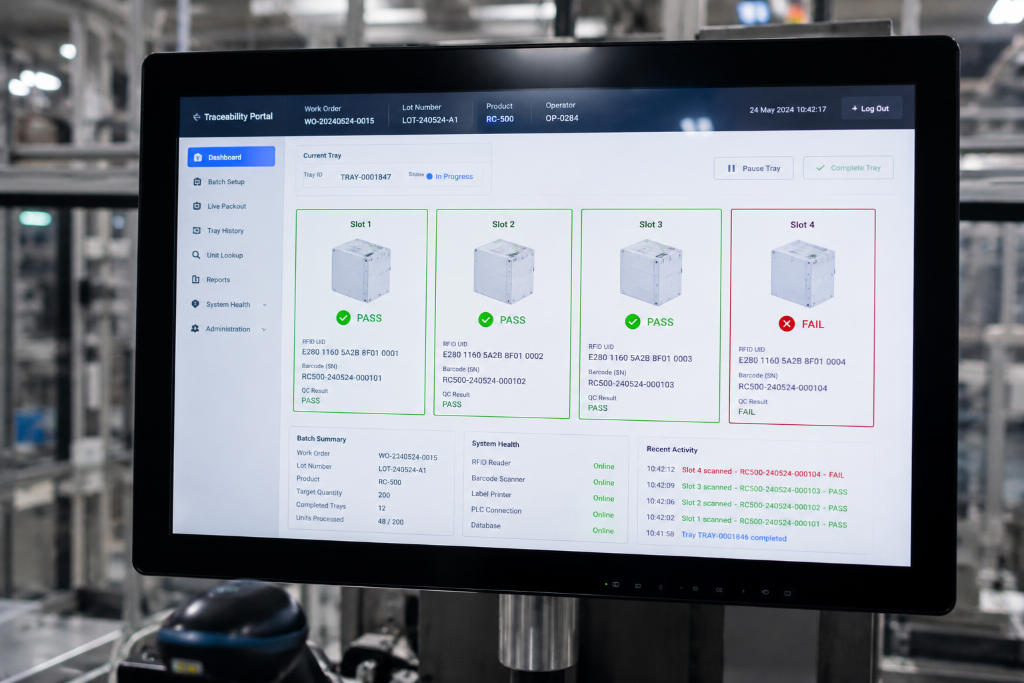
The client's reagent cartridge line runs multiple automated inspection stages upstream, but needed a final human-supervised packout stage as the last line of defence before product shipped. At this stage, four cartridges are grouped into a tray, and each one has to be cross-checked against everything the automated line already knows about it - RFID identity, barcode serial number, and prior QC pass/fail results - before the tray can be sealed, labelled and released with a defensible audit trail. The requirements were unusually strict for a "packout" step: · Every cartridge's RFID UID and barcode had to match a single, unambiguous QC record - no ambiguity, no silent fallback. · The station had to run on a locked-down industrial PC with strict endpoint security policy, ruling out several standard deployment approaches. · Full traceability data had to be captured per-tray and per-unit, exportable on demand and on a schedule to downstream reporting systems. · The system needed to run unattended for long shifts without human intervention if the network blipped or a reader briefly dropped.
The Solution
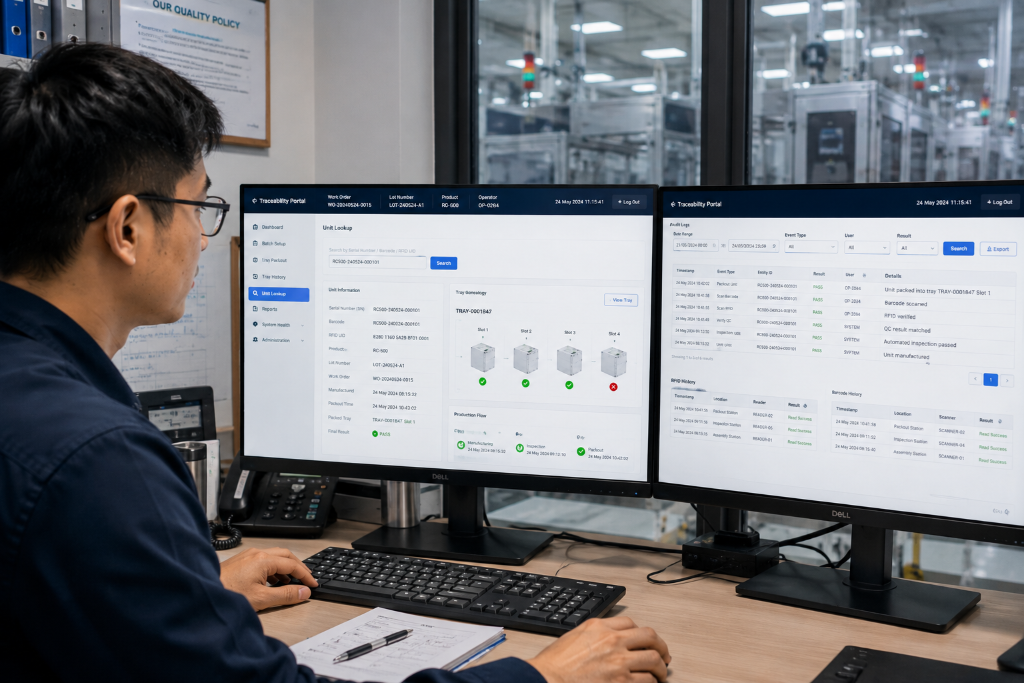
A kiosk-mode web application running directly on the factory floor workstation, built around a strict verify-then-commit workflow: · Batch setup - operator selects product model and enters work order / lot information, validated against permitted formats before the batch can start. · Live tray scanning - as each cartridge is loaded, the system reads its RFID and barcode, cross-references upstream QC data in real time, and displays an immediate pass/fail decision. · Tray completion - once all slots in a tray pass, the system prints a uniquely numbered tray label and resets for the next tray; failed units can be reloaded and re-verified without breaking the batch. · Traceability lookup - any unit or tray can be looked up after the fact by serial number, work order or lot, showing the full chain of QC and packout data. · Administration & audit - role-gated access (operator / supervisor / engineer tiers), full activity logging, and a system health view covering every connected reader and the label printer.
Technical Highlights
· Modern server-rendered web application framework with a relational database backend, running as a background service - no browser-based state, so a workstation reboot or browser crash never loses in-progress data. · Direct integration with PLC-driven hardware over a dedicated operational technology network, using persistent local connections rather than typical web APIs, chosen for the low-latency, high-reliability characteristics factory automation demands. · Engineered for unattended resilience: automatic reconnection and resynchronisation after network interruptions, and background polling processes isolated so that a transient hardware fault can't take down the whole application. · Delivered under strict endpoint security constraints (no single-file or self-contained deployment shortcuts), requiring a deployment approach compatible with the client's application allow-listing policy. · A disciplined versioning approach was introduced mid-project after discovering inconsistent version reporting across pages - consolidated into a single source of truth referenced everywhere the version number is displayed, closing a class of bug before it could recur. · Data-integrity issue found and resolved through live production data: an identity field was found to be recording the wrong value across historical records; root-caused, fixed at the source, and backfilled with a verified SQL correction across affected rows. · Export logic hardened after discovering a boundary-condition bug in date-range filtering that could silently drop the last record of a range - caught, fixed and verified against real production data before it affected a report.
Documentation & Delivery Discipline
Beyond the software, the engagement included a controlled documentation suite maintained to the same revision discipline as the code: · A data field reference and audit document, mapping every field captured by the system back to its source and format, revised and re-approved as the client's own data requirements evolved. · An end-user guide with screenshots and step-by-step instructions for every workflow, kept in step with each portal release. · A build and change history document giving a full audit trail of every version shipped, from initial release through ongoing refinements.